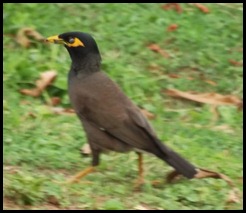
Jungle myna


Scientific name:- Acridothers fuscus


General features:-   Tufted forehead and white wing patch and tail tip; lacks bare orbital skin.Juvenile browner with reduced forehead tuft.Found near cultivation, well-wooded areas, edge of habitation.


                Commonly found in hilly areas and forests, but have been found in habitual areas like in thrissur and Ernakulum. Size, sounds, behavior, food, life style are all almost similar to the common myna. Differences in appearance with common myna include the absence of yellow skin near eyes and a more brownish grey colour, and presence of a feathery tuft above the beak.

           DSCF7753

               Jungle mynas are seen to nest as a group having about 10-20 nests side by side to each other,they usually nest in tree holes, in fissures on walls or ojn palm leaves. Eggs have a characteristic blue colouration without markings.

                    DSCF7752 

              Both mynas are good friends of farmers as they keep in check the number of insects feeding on crops. They can be frequently seen near or about cattle's. When they are feeding in the open they feed on insects fleeing from the large animals foot paths. They are known by many names in Hindi, in some areas of India meaning the-“cattle herders”.

common myna


Scientific name:- Acridotheres tristis


General features – Brownish myna with yellow orbital skin, white wing patch and white tail tip.Juvenile duller.

                               Found near habitation and cultivation.


                                     Common mynas are found commonly in towns ,villages and near cultivation areas all around Kerala.Although they perch in trees, main food source comes from ground foraging. While flyinng you can notice a white patch along their wings and end of their tails.                                      DSCF0457

                                   Just like crows mynas are commonly not afraid of man and readily take up food thrown as waist.Their natural diet include maggots, worms, earthworms, insects, seeds, fruits, grains etc.Seen in groups of related individuals(20-30 birds).Consists of pairs or small groups of related birds. Unlike some birds their mode of foraging on the ground consists of walking on both legs like the way humans walk.They are among the most courageous birds able to fend of predators such as snakes, owls etc. and have been observed to procure the nests of other birds by aggressive take overs.                         

DSCF8652  

                                When seeing predators such as snakes, they flock together and make a characteristic alarm call, which itself will deter the less courageous attackers.Mynas are seen to be highly vocalized among birds able to make a wide variety of sounds to convey messages between them. They have been seen to mimic other bird calls. They usually become silent at night when they often share their rest place with other birds.                         DSCF8651 

                               Common mynas like crows are seen to nest as separate pairs rather than as a group like jungle mynas. Eggs have a characteristic blue colouration without markings, they have been seen particularly fond of the ’cellophane’ packing's like in cigarettes while during nesting periods. They have been found to be fond of nectar particularly of trees such as “poola”,”murikku”,”plashu” and can be seen using them in the flowering season.

Birds found in Kerala-Kerala golden-backed woodpecker


Scientific name – Dinopium benghalense

General description-
         Backside-greenish-yellow colour body and tail having same colour-black.their sound goes as “kler-kler-kler-kle-kle-kle”.male-head region is red 'female-part of head region and scalp are red.
woodpecker1
 
                             There are about 12 varieties of woodpeckers found in Kerala out of which there is the sparrow-sized speckled piculet to the crow sized great black woodpecker.colourn variations between them are astounding.Almost all of them have a ‘cap’ above their heads.
woodpecker2
             Their legs have a unique pattern of toe arrangement seen only in them, with two toes facing forwards and two toes facing backwards and have sharp claws for gripping the bark of trees.The sharp and strong feathers that they have in their tail feathers act as extra insurance in the form of grip when these birds are climbing trees vertically.
woodpecker3
        They have specialties in their tongues and beaks in that the beaks acts as a multipurpose tool for foraging and nest building.Their tongues are peculiar to any other bird tongue in that their tongues originate from the forehead region and passes between the eyes through special tubes and end in the throat.Their tongues are used in astonishing speed  and accuracy to collect worms and insects from deep burrows in tree trunks.
woodpecker4
         Their courtship music comprises of trumpet music from hollow trunks produced by the stamping of beaks.
         They built nests by chiseling out small pieces of bark out of the wood just like a carpenter does.when the nest is complete they lay their their eggs on the floor of the nests just like mynah's.
woodpecker5
                 The woodpecker that is being discussed here is common in all parts of Kerala and is seen in almost every backyards.
External links:

Birds found in Kerala-INDIAN KOEL


Indian koel  :-
Scientific name:- eudynamys scolopacea
General features:-
                              
                          Female sometimes known as spotted koel.male with red eyes and black body.female is brown coloured or reddish brown in colour with white dots or lines covering the body.
Malayalam names:- (കുയില്,കാക്കകുയില്,കോകിലം)
male koelfemale koel
                                 male                                                                  female      

                                     There are many varieties of koel in Kerala.the common sounds of ‘koovu-koovu,are of the common koel.there are many mystical stories about koels in Kerala,one of them being that they bring “red-eye” diseases for children.
DSCF0407

Most of the members of the koel family have a characteristic behavior for them.They don’t build nests themselves but utilizes the space and care of other bird,mothers, by laying eggs in their nests and letting them raise their young ones.
The Indian koel usually lays eggs in the crow,s nests.when the time for nesting comes a female koel searches for a suitable nest for laying.they lay their eggs in the crows nest when they go for foraging or when  a time comes when the crow pair is not in the nests vicinity or by outsmarting them by tricks.they lay their eggs quickly among the crows eggs.
DSCF0418
By way of evolution,the eggs of both crows and koels have been designed to look alike and  so the poor crow pair usually never notices one or more of the koels eggs among their own and start incubating them all.
DSCF0421
Immediately after the koel egg hatches some extraordinary and terrible(or so) things happen in the crows nest.before even their eyes open the koel chick vibrates or spasms out vigorously and pushes out the other crow eggs which have not still hatched and ensures that the fod the crow pair collects will be available for it.this is a phenomenon which have been perfected by the koel chicks to ensure the survival of its kind.this behavior is said to be an involuntary natural response to its kind perfected over the years(evolutionary years).and more over the koel chick is a;almost a perfect look-alike of a crow chick as long as it is dependent on the crow pair for survival,even the females striped color or appearance appears after the nest-dependent phase of its life  is complete.
These are examples of natural adaptation of species occurring around us perfected by evolutionary natural selection.
DSCF0423
Even today the truth behind the koel-crow relationship is only vaguely known to scientists.there are many views among them that the bird chick(koel) doesn’t actually kill the other eggs by pushing it down and that the koel will care for their young ones once they are hatched.
Not only does the koel give its housekeeping duties to other birds but also is said to attack other bird nests for eggs.
DSCF0428
             
                  How did a species get to be so selfish and so adapted to its methods??
The answer is not simple but to explain briefly,every organism in this earth have acquired certain qualities in time for ensuring the better sustenance of its kind,for example our hands are the result of evolution from front legs of other former species.the same process culminated in the case of koels with the result of their cunningness and dependence of their nesting life for other birds.
DSCF0429
                         In earlier times when first the species of koel emerged the could have been normal birds like many others,racing their young ones themselves,but in time a smarter bird came into being or circumstances of nature led to the development of the species to that of a nest borrower and this single change could be the reason of the behavior in it developing as a new species.The proof that this behavior led to the development of a separate species can be seen even today in the “southern caucal”,which is a neighbor species of the koel who have developed the normal behavior of nesting  themselves.
other sites for reference:

Birds found in kerala-WHITE BREASTED KINGFISHER


WHITE BREASTED KINGFISHER

scientific name: halcyon smyrnensis
Malayalam name:   (മീന്കൊത്തിച്ചാത്ത.)
general description:-   [head neck and underside of body is chocolate coloured.throat,chest and chin are white coloured.upper surface of body is blue coloured.adult birds have dark red beaks,seen commonly in Kerala.]
kingfisher3
                    Found equally in cities and rural areas.this bird doesn't require the presence of water bodies to survive.They equally prefer aquatic animals as well as ground dwelling lizards,insects and small snakes etc..
                           Normally they travel lonely.they spent most of their time looking for food in dry areas such as forests,teak plantations etc.their method of foraging resembles that of DRONGO’s and BEE-EATER’s in that they position themselves in a higher platform and watch the ground for movement,and when they spot something , they scoop down and grabs it.
kingfisher4
                      When termites take to the air, they are found to chase them in mid air for feasting.When the prey is difficult to eat or is difficult to chew down their beaks,they take them back to a branch and squash them by beating the prey on the branch rigorously and then eat it slowly.
                    Although not that dependent on water like other kingfishers they are seen to do the ‘still air’ flight like the other ones.
                         Their sounds can be heard commonly in every backyards in Kerala.it goes as ‘kre-kre-kre’ or’kle-kle-kle’ and resembles a hoarse laughter.during the season of rain (monsoon) their sounds turn into ‘kilu-kilu-kilu’ and signifies the time of their courtship season.They are often seen to fly around rigorously while doing this.
from Wikipedia
          Although they nest from February,most nests are seen during the commencement of rainy season (April).Their nesting behavior is similar to that of other kingfishers but are also seen to dig their nests in ridges found in paddy fields and wells.They don’t necessarily require water bodies near their nests.

Lizards found in Kerala-GREEN FOREST LIZARD

GREEN FOREST LIZARD

DSCF0237
                                                        scientific name: calotes calotes
DSCF0241
young male
DSCF0236
Adult male(from Wikipedia)

Birds found in Kerala-RED SPURFOWL

RED SPURFOWL

scientific name:- Galloperdix Spadicea
                                   Smaller than a jungle fowl,with darker more deeper reddish-brown coloured body is a forest bird.Although of the fowl family,(including domestic fowls) males don’t have the long sickle shaped tail feathers characterized in male members of the same family but is rather similar to the tail feathers of its female counterparts(small medium length feathers),nor does they have cockscomb’s in their head or throat like their domesticated cousins.They do have a distinct reddish skin exposed around their eyes which mainly helps us in distinguishing these creatures.
spurfowl male
                                    They get their name ‘spurfowl’ from their distinctive spurs or nails behind their feet(facing backwards)with males usually seen having two to four of them,whereas the females found to have only one or two.
spurfowl female
                                       Females are quite similar in appearance to males except for black lines cris-crossing their body.The feathers on their heads are longer than that of the body and are seen held raised like a ‘fan’.
male and female
                                          Their habitat usually comprises of valleys,mountain sides,shrub forests and bamboo forests.extremely shy creatures,often seen only when they run from you covering in thick undergrowth.although with wings they prefer running than flying.they are quiet good runners on feet.behavior is similar to that of jungle fowls.they usually prefer tree branches while resting for the night rather than the ground for protection against night active hunters.their sounds resemble that of domesticated fowls but with shorter and deeper sounds.
male and female
                                     They are usually seen in cashew plantations and near residential areas in north Kerala where they thrive and breed.
           EXTERNAL LINKS                              

Birds found in Kerala-CROWS

crows

There are two type of crows found in Kerala:-
1)JUNGLE CROW-corvus macrorhynchos.
2)HOUSE CROW- corvus splendons.
                          There is no need in describing the crows to Indians or in that matter any south-east Asian countrymen,as in fact the first bird a man in these areas usually come across are crows (their species do live in other countries though not called ‘crows’…),dirty,smart,garbage dwelling crows.But interestingly the common knowledge about these amazing birds ends there.the fact that two or more species of birds (crows)exist among us is mostly unknown.there are even mistaken theories of crows as being of two different genders of the same species.so I am trying to explain it in a brief manner.                     crow2
     There is essentially two species of crows found in Kerala.the larger and darker JUNGLE CROW and the lighter and smaller HOUSE CROW.compared to the house crow,the jungle crow has darker much deeper dark colour(with a deep bluish accent) covering its body and feathers.whereas the house crow has a greyish colouring on the neck as well as legs.
                      One bird that could be mistaken for a crow,is the koel.but it has its differences with the koel in that the koel is built on a much leaner design than crows.crows lack the swiftness or agility of koel and if you can mention it koels lack the courage to co-exist with human beings as crows do.Although morphologically different jungle and house crows have the same social structure.they move about in small groups often mixing up during foraging.they are one of the most intelligent among animals(birds).
DSCF0155 
koel
DSCF0175
crow
                           They are superb adapters to the modern world so much so that they have been seen to use man-machine power in their quest for survival.they have been observed recently to crack nuts by placing them in heavy traffic,so that the weight of the vehicles passing over it may crack it for them!!.
                         Although it may seem to us as a nuisance the presence of crows in cities and other human settlements are essential for a balanced ecology.crows function as the garbage dumps of nature,consuming the ever increasing organic wastes dumped by man.they do the same role in cities as vultures in the African savannahs.
                           They may split up into many groups while foraging but come back to a single tree or so during the night.their menu cannot be listed as it includes anything a creature can eat(except maybe fresh leafs etc.).in a way its their secret to successful adaptation.the fact that they can eat almost anything and that they have less natural predators increases their survival rates everywhere.
                        During foraging and resting they intend to be in groups ,during mating  season they keep to their  partners and separate for nesting.crow nests could be observed in months except the monsoon periods,but one could say that December to June period is their nesting time.everyone knows the stories  of the koel that lays its eggs in the crows nest for it to nurture and raise.but apart from a story,scientists are finding out how exactly did this kind of behavior come into existence in the evolutionary tree.in fact the koel  have so much adapted for laying its eggs in crows nest that its eggs now almost actually resembles crow eggs in shape,size and even colour.their nests are made up by twigs and fibers from trees and cushioning up the center with hair ,cotton stripes etc. for laying the four or five eggs for incubation.they usually lay their eggs in big trees such as jackfruit tree,mango tree etc.
cf2
crow flock
                        As we have all observed crows are some of the most “smartest” of all birds, in fact crows have been put next to dolphins in the most intelligent of all animals.crows are found to experiment with their surroundings, and innovate new ways of the life according to their changing environment.
                           As we conclude crows are amazing animals who have been provided with intelligence enough to challenge any obstruction put before them and it is our duty to protect and study them to make both our lives better.
External links:
  1. Wikipedia
  2. www.birds.cornell.edu 
  3. birding

Check out Save Our Tigers | Join the Roar

Title: Save Our Tigers | Join the Roar
Link: http://gotaf.socialtwist.com/redirect?l=-451407760715479003611

The Lion of trees

      247_4779_ltm

               Black body,a mane like a lions,small short tail,tail that also resemble a lion’s,…so goes the similarities between the name and the monkey.Watching from a distance it almost look likes a black lion cub in trees….In many things lion tail macaque’s differ from their relatives.Among the monkey species,lion-tails are one of the most oldest groups of macaque’s(Macaqa Cinelus).

            They mostly give birth to one offspring at a time,but twins have rarely been reported.Lion-tail’s milk their offspring for about 12 to 18 months,they reach adulthood by about 2.5 to 4 years.avg. lifespan of a lion-tail in the wild is 25 years,but in captivity they have been known to reach 38 years.Like most other monkey groups,lion-tails move as a group.Avg. number of members are 20 but groups up to 43 have been found.There may be one to three adult males in a group.the ratio of male to female in lion-tails have been found to be 1:5.when observed closely you may notice the “social hierarchy” present between individuals of a group.  

                 2007050903360201 

                    They usually make a low sound,like “ku.. ku..’ to communicate with each other.they usually have a roaming territory of 5 to 6 trees,usually dwelling above a height of 25m.They use diversional tactics to ward of enemies.The most talented males play decoy for the rest of the pack to run to safety.They are preyed on by tigers,leopards and pythons.Lion-tails are the most intimate friends of evergreen forests(western ghats) it seems.they are mostly seen in “non-human” areas of forests,in regions of Karnataka,Tamil nadu and Kerala.Their concentrations are mostly in Silent valley of Kerala and kalakadu-Mundanthuri tiger reserve(Asambu hills) of Tamil nadu.And so,these forests are of utmost importance to their survival.


                   The largest number of individuals of lion-tails are found in Kerala’s Silent valley-Attapadi reserve-new Amarambalam reserve(a chain of rain forests),about 2000 individuals.Their dietary habits are quite different from other monkeys.It mostly consists of fruits,nectar of flowers,small insects etc.Under advanced studies it is revealed that they depend on 92 trees and plants for survival.

                One could say that lion-tails have become an indicator for a healthy rainforest.They are one of the most '”tree dwelling”among all the monkeys in the world.Studies conducted from 1993,of a lion-tail group revealed that out of 15000 sightings for 5 days(every month) for 5 years,only 7 sightings were reported to be on land.

               ltm-1

                   We have to conserve the forests to ensure the existence of this wonderful creature or its “lion-tail were..” in future….

“web” masters!….

DSC00192
possibly (argiope anasuja)
Although they seem creepy and all,with eight legs and a hairy body, spiders are some of nature’s most wonderful engineers.The way they seem to make their webs is still a natural wonder to all.spider webs are used for capturing prey(from tiny insects to even birds),bird eating spiders are actually tarantula’s,which don’t use webs,but rely on their size,venom power and speed to capture prey.Spider webs are actually proteinaceous spider silk extruded from their spinnerets(web-silk producing organs in their abdomen).Although they built nets in many ways,most of them are circular with intricating networks of web inside it.Spider webs are sticky in nature,essential for catching flying insects.
The tensile strength and power of spider-silk can be compared to metals and modern-day plastic filaments,they are also extendable extending up to 140% of their original length.Spiders are commonly feared and ill-treated(Arachnophobia),but they actually help us in controlling the insect-pest population,especially around houses and other human settlements.